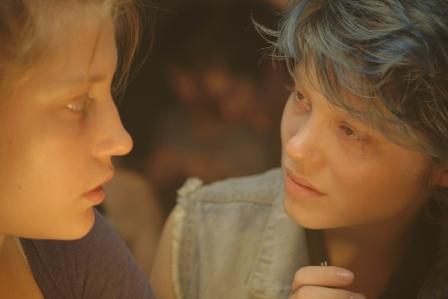
Blue is the Warmest Colour may have only just reached our screens, but it has already lived a full and turbulent life in the media. A three hour film detailing the sexual awakening and first love of a young lesbian woman featuring lengthy and explicit sex scenes, it was always destined to cause a stir. Greeted by waves of critical acclaim at Cannes, it was awarded the Palmes D’Or. Since then, the film has been lauded as a masterpiece by some and castigated as exploitation by others (including one of its stars). My own take on the film lies somewhere between the two; as a deeply flawed film that is at times elevated to great heights by bursts of passion and intensity.
Adèle Exarchopoulos plays fifteen year old Adèle- a quiet, thoughtful girl who is popular at school and aspires to be a teacher. After her first sexual encounter with a boy leaves her unmoved, she begins to question her sexuality. During a tentative first trip to a gay bar, she meets blue haired art student Emma (Léa Seydoux). Older and more experienced, Emma is attracted to Adèle’s sweet naivety and the pair begin a friendship that turns into a passionate love affair.
Though the film represents an unprecedented frankness in its depiction of lesbian sex, the way in which these scenes are shot feels somehow regressive. Throughout the film, we have seen a preponderance of tight close ups on Adèle’s face as she engages in intimate activities; eating, sleeping etc. During the sex scenes however, the camera presents her body in pieces, an aesthetic that closely adheres to the male-oriented gaze and conventions of pornography. Seen out of context, these scenes would hardly be praised as revolutionary.
Conversely, it is the romance that makes the most realistic impact. For this we have Exarchopoulos to thank. As the young girl in the first throes of love and lust, her performance is remarkably unaffected and raw. Elsewhere, elements of the story unfortunately fall flat – the burst of homophobia Adèle suffers at school feels unrealistic in tone and Emma’s friends and family are a collection of pseudo-bohemian stereotypes. Emma herself in fact feels underdeveloped as a character, an object in the life of Adèle, rather than a subject in her own right.
The original title of the film is La Vie d’Adèle – Chapitres 1 & 2 and indeed the camera rarely leaves her; if the film falls down in other areas, it is perhaps understandable. Nevertheless, despite its many flaws, this is a film of great vitality which demands to be seen.