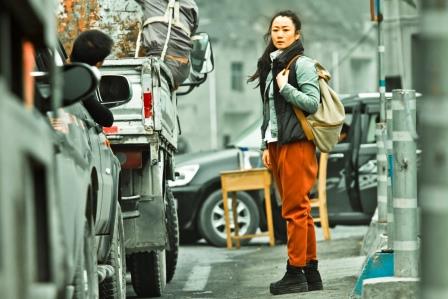
There is nothing more powerful than a well aimed shot of anger and perhaps nothing so difficult to convincingly pull off. The bursts of sudden and extreme violence in writer/director Zhangke Jia’s A Touch of Sin, have drawn comparisons with the work of Quentin Tarantino. While one sequence in particular seems to stand up to this comparison in terms of visual style (a young woman defends herself against a pair of middle aged attackers in a gaudily decorated sauna), stylistically and thematically the comparison doesn’t hold water. While Tarantino’s violence is all shiny surface, Jia uses violence here as a shocking articulation on the state of a nation.
The film takes as its springboard four true-life cases of seemingly random acts of violence and builds a series of four stories around them. A downtrodden man takes violent revenge against the corrupt leaders of his village. A young father turns to a life of crime and cruelty to support his wife and son. A woman working as a receptionist in a sauna is forced to fend off a sexual attack from her customers. A factory worker is displaced from his home in order to make a meagre living. Jia uses these seemingly unconnected incidents to build up a treatise on how China’s economic growth has left a huge section of its society in dire straits.
Each story is told and played exceptionally well, so that when the acts of violence occur, they are legitimately shocking and disturbing. I did however experience something like cultural dissonance while watching A Touch of Sin. The travails of the working classes of China are so alien to our own, that at first I found it difficult to get to grips with the filmmaker’s intentions, particularly in the move from the first to the second protagonist. Far from being frustrated however, I was intrigued; this is the kind of film whose complexity begs a second viewing and invites further study of its subject.
A vital contribution to contemporary Chinese cinema, A Touch of Sin is a visceral but coherent piece of filmmaking that draws the curtain on contemporary China, building a troubling picture of a society mired in desperation and displacement.