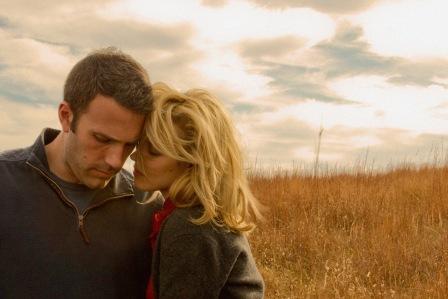
To the Wonder; a meditation (because let’s face it, Terrence Malick doesn’t do “films”) about love, God and what happens in their absence, could also be described as, two hours of Olga Kurylenko twirling through fields. A glib description I know but that’s how it felt to me. Malick is a truly divisive director and I find him to be a uniquely gifted but uniquely frustrating talent. His films are incredibly beautiful, but for me there is a disconnect between Malick’s intentions and the effect of the finished product on screen. Ideas-driven filmmaking is something to be treasured of course, but the punishing monotony of To the Wonder made it irritating rather than enlightening.
The film begins at the beautiful Mont Saint-Michel in France, where lovers Marina (Kurylenko) and Neil (Ben Affleck) are exploring the beautiful, ancient surroundings. They then move on to Paris, where we discover that Marina has a young daughter. After a brief time in Paris, the three travel to Neil’s home in Oklahoma and we follow their relationship through its ups and downs as Marina struggles with her new home and Neil reconnects with an old flame (Rachel McAdams). Meanwhile, a local priest Father Quintana (Javier Bardem) finds himself questioning his vocation.
All this is accomplished with very, very little in the way of dialogue. Instead, we hear the philosophical musings of Neil, Marina and Father Quintana in voice-over. For me, this lack of dialogue is a huge problem and the proliferation of scenes where Affleck silently follows a twirling, prancing woman (first Kurylenko then McAdams) through various landscapes is self-indulgent to the point of parody. Certain scenes actually work fantastically well (for example an effective admission of infidelity) but for the most part, Neil and Marina’s thoughts are excruciatingly corny and contrived – for example: "Newborn. I open my eyes. I melt. Into the eternal night." Javier Bardem’s strand works much better. As he struggles with his faith and the presence of God in the world, there is a genuine emotional and philosophical weight to his inner monologue.
The visuals are undoubtedly the film’s trump card – less experimental than Tree of Life (no dinosaurs here) but sharing that films sun-dappled beauty. Unfortunately, this beauty could not compensate for To the Wonder’s other myriad downfalls.