The Irish travelling community have taken up something akin to a permanent home on Channel 4, where the popularity of the Gypsy Wedding series and its attendant spin-offs show no signs of waning. This would seem to be the perfect moment in time to redress the balance against that arch cultural voyeurism with something a little more thoughtful. Writer/director Mark O’Connor’s King of the Travellers is certainly that – it positively seethes with earnestness and wears its heart on its bare knuckles.
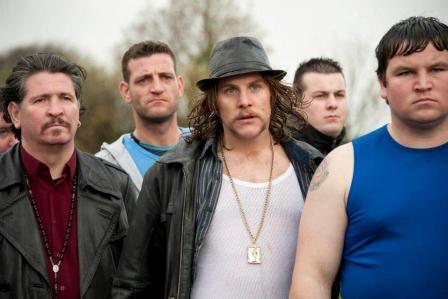
The story concerns a long running feud between two families, the Moorehouses and the Powers, who have taken up residence on neighbouring pieces of waste ground on the outskirts of Dublin. The lives of these travellers are more hardscrabble than the dayglo glamour of their reality television counterparts; their trailers are lodged in the mud and there isn’t a rhinestone in sight. Our hero is John Paul Moorehouse (John Connors) a quiet, burly young man who believes that the Powers were to blame for the death of his father when John Paul was just a young boy. Though initially bent on revenge against the Powers, his resolve is tested when he falls for the daughter of the clan.
Narratively, King of the Travellers is a bit of a Frankenstein’s monster – part Hamlet, part Romeo and Juliet, with a healthy dose of The Godfather and On the Waterfront thrown in for good measure. Inevitably, the film never reaches the heights of these influences and makes an uncomfortable crash landing in mediocrity. Some of the dialogue doesn’t ring true (dumbass isn’t a term most Irish people would reach for in an argument) and the acting in the supporting roles is a little uneven in its quality.
There are two performances though that hold our interest throughout. Connors as John Paul is an unlikely leading man but has a gentle-giant quality about him that is hard not to warm to. Michael Collins as the Moorehouse paterfamilias Francis also fares well, his showman persona providing a nice contrast with his brooding nephew. Ultimately though, these performances cannot combat the predictability of the narrative. A failure then admittedly, but a noble one.