So it’s come to this; the release of a new Lars Von Trier film and one of its stars is making a bigger social nuisance of himself than the director. Yes, while Shia LaBeouf sets himself up as an art installation with a paper bag over his head, Von Trier maintains a (relatively) dignified silence as Nymphomaniac hits screens in two volumes. This lack of controversy seems to have disappointed a lot of people. Many reviews of the film released since its one day release as a 4 hour whole have criticised it for not being as shocking as they had expected. It’s an unfair and immature criticism that seems to be based more on the reputation of the filmmaker than on the film itself. Of course, the title and publicity material may be intentionally provocative but as a piece of work, Nymphomaniac is much more than an empty vehicle set to raise the moral heckles.
The story begins with a beaten and bloodied woman (Charlotte Gainsbourg) lying in a snow covered lane. A passing man (Stellan Skarsgard) takes pity on her and brings her to his house to recuperate. The woman is Joe, a self-diagnosed nymphomaniac, the man is Seligman, a bachelor who lives a monkish existence. Inspired by items she sees in the room, Joe begins to relate the sexual history of her life from her childhood to the present day.
Volume I, is dominated by Stacy Martin who plays Joe from adolescence to early womanhood. Martin has a lovely nymph like quality, her broad innocent face and softly spoken manner acting as an interesting counteraction to her voracious behaviour. The first volume is quite light-hearted and often genuinely funny. The moments of absurdity in the events of Joe’s life are consistently punctured by the reactions of Seligman, be it his long-winded comparisons between sexual licentiousness and fly fishing or his protests that Joe’s story is too full of coincidence to be taken seriously.
The sexual content in and of itself isn’t shocking – anyone who’s seen 9 Songs or more recently Blue is the Warmest Colour or Stranger By the Lake will be familiar with the kind of frankness that we see on screen here. It is absolutely necessary for the narrative, in fact it is the narrative. As such, it never feels exploitative or titillating. In fact it is the opposite, particularly in Volume II. Later in her life, sex has very much become a destructive force in Joe’s life. She may reject the sanctimonious help offered at a meeting for sex addicts but she is very clear that her addiction has brought her loneliness and disaster. The sequences with Jamie Bell’s business like sadist K is particularly telling – in search of that elusive thrill she suffers pitiful humiliation at his hands.
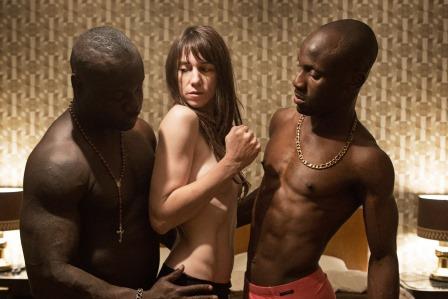
This change of tone is palpable in Volume II, as Von Trier’s playfulness departs in favour of darkness. Joe chases the high of gratification and both her life and her body begin to fall apart. What was once a playful sexual epic now becomes poignant and tragic. As Von Trier follows Joe into the depths, there is some content which could be seen as questionable, most notably the evocation of the myth of the animalistic black man as Joe attempts to take an African lover. However, Gainsbourg has a talent for the melancholy and her performance is moving and pitiful, rather than exploitative.
The supporting cast vary in quality but certainly give it their all. In one brilliantly awkward scene, Uma Thurman makes a standout performance as the hysterical wife of one of Joe’s lovers. The aforementioned LaBeouf, the one constant of Joe’s life, is a tad more unsatisfactory. His performance is actually incredibly committed and at times touching but his attempt at a British accent is frequently distracting. A shame; why he couldn’t have kept his own accent like the rest of the international cast is anyone’s guess.
Like all of Von Trier’s work, Nymphomaniac is visually quirky and often stunning. Fans of his work will not be disappointed but at the same time I actually found this to be his most broadly accessible film. No shocks then, just an absorbing, eccentric odyssey.