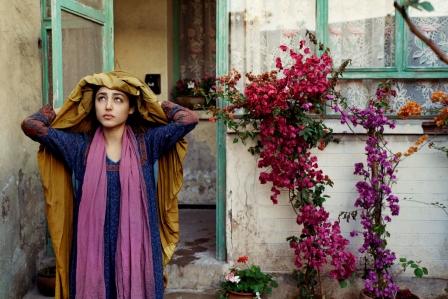
In an unidentified war-torn Middle Eastern country, a woman in her thirties prays over the bedside of her older husband as he languishes in a comatose state with a bullet lodged in the back of his neck. Although the militia approaches, the woman is unable to move her husband to safety. Her Aunt tells her the Persian legend of the patience stone – a stone to which one tells one’s deepest anxieties and secrets, which then breaks and releases the confessor from their torment. As the woman braves danger to attend to her husband, she begins to use him as her patience stone, revealing the secrets she has kept from him throughout their marriage.
So the scene is set for an unusual and absorbing drama, based on the novel of the same name by the director Atiq Rahimi. Although initially the scene seems to be set for a harrowing war film, it soon becomes clear that The Patience Stone is about a different type of conflict. The approaching war and the state of her husband act as a trigger for the woman to finally meditate on her life and on the injustices she has been thrown against as a woman in a strictly religious society.
At the centre of this, Iranian actress Golshifteh Farahani is a magnetic presence. She delivers her dialogue in a dreamy, unmannered style, her eyes glazed as she revisits her memories. The effect is mesmeric, as if one was eavesdropping on someone’s private thoughts. As she reveals more secrets to her unresponsive husband, I was drawn more and more into her story.
Atiq Rahimi’s direction allows Farahani to be the focus of the piece, while also bringing a great deal of visual style to the screen, with interesting use of framing. While, perhaps inevitably, the script is heavy with the woman’s monologues, the use of flashback means that there is always something of visual interest to complement Farahani’s delivery.
An absorbing and contemplative drama, The Patience Stone is a rewarding experience, with Farahani at its centre delivering one of the year’s best performances.